Echinacea
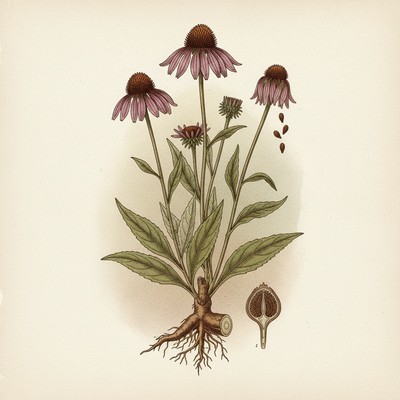
Echinacea purpureaEchinacea, also known as purple coneflower, is a North American prairie plant and was a cornerstone of Native American medicine, where it was used for a wide range of ailments. Today, Echinacea purpurea belongs in the immune category. It is traditionally used to support the body's natural defenses and overall immune system wellness. Timing matters, too. This herb is not for long-term daily use, and traditional practice reserves it for acute situations instead of a cup each morning.
Traditionally used for
- Support the body's natural defenses during cold and flu season
- Reduce the duration of occasional seasonal illness
- Support overall immune system wellness
Quick facts
Pairs well with
Common questions
Can you mix echinacea and elderberry?
They name each other as partners, and both fall within the immune category, so pairing them reinforces one job rather than covering two. Elderberry tastes sweet-tart and berry-like, giving echinacea's earthy bitterness something to rest on. Equal parts is a good starting point. One rule is essential: raw elderberries are toxic and must be cooked. Both herbs are flagged for autoimmune conditions, immunosuppressant medications, and a pregnancy caution. Elderberry is also flagged for blood sugar medications and diuretics.
Can you mix echinacea and ginger?
Ginger is included on echinacea's pairing list, though they serve different roles. Echinacea sits in the immune category, while ginger is traditionally used to ease nausea and warm the body, making this more a flavor choice than a functional one. Ginger's spicy heat and citrus edge mask most of echinacea's earthiness and unusual tingle. Use ginger lightly because it can quickly dominate a cup. It may increase bleeding risk with blood-thinning medications, may lower blood sugar, and is best avoided in high doses before surgery.
What does echinacea tea taste like?
Echinacea tastes earthy and slightly bitter, with an effect most herbs lack: a faint tingle on the tongue. That sensation can surprise people at first. Echinacea purpurea does not make a delicate floral cup, and people do not drink it for flavor. When the bitterness feels too strong, astragalus, another herb from its pairing list, is mildly sweet and softens some of the edge.
What is the difference between echinacea drops and echinacea tea?
Drops are a tincture, which is a concentrated liquid taken by dropper instead of by the cup. Echinacea comes in four standard preparations: tea, decoction, tincture, and capsule. For a decoction, the plant material is simmered rather than steeped. The choice mostly comes down to effort and your tolerance for bitterness, because the cautions remain unchanged in every format. All four forms of echinacea are easy to find.
Does echinacea help you sleep?
Its traditional uses do not suggest that. Echinacea falls into one category, immune, and is traditionally used to support the body's defenses. Nothing recorded concerns rest or relaxation. There is also a practical reason against drinking it nightly: echinacea is not intended for daily use over a long period. In any case, a bitter drink that tingles makes a rather unusual bedtime routine.
Who should avoid echinacea?
People with an autoimmune condition and those taking immunosuppressant medication should avoid it, because echinacea is flagged for both. Allergies are another major concern. Anyone sensitive to Asteraceae family plants, including daisies and their relatives, may react to echinacea. Use caution during pregnancy. A final caution applies to everyone: echinacea is not intended for long-term daily use and is reserved for acute situations.
Can you grow echinacea in containers?
Yes. Purple coneflower grows well in a pot, so a balcony or deck provides enough room. Dried echinacea is also easy to find, reducing some of the pressure to grow it yourself. Your harvest can be used for the same preparations as purchased echinacea: tea, a decoction, or a tincture.
Safety
Avoid with autoimmune conditions and immunosuppressant medications. May trigger allergies in those sensitive to Asteraceae family. Not for long-term daily use (use during acute situations). Use caution during pregnancy.
These statements have not been evaluated by the Food and Drug Administration. This information is not intended to diagnose, treat, cure, or prevent any disease. Always consult a qualified healthcare provider before using herbs, especially if you are pregnant, nursing, taking medication, or have a medical condition.
More from the herb library
Blend Echinacea in the Yarrow app
Browse 100 herbs, build your shelf, and create blends from what you have.
100% Ad-Free · Some features require premium