Schisandra
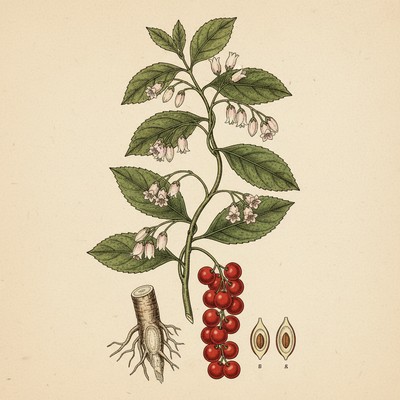
Schisandra chinensisSchisandra berries, known as Wu Wei Zi in Chinese (meaning 'five flavor fruit'), have a unique taste that is sweet, sour, salty, bitter, and pungent all at once. This intriguing berry has over 2,000 years of use in traditional Chinese medicine as an elite tonic herb. Schisandra is prized for its dual action: it's an adaptogen that improves mental concentration and endurance, and it's also hepatoprotective (liver-protective), commonly used to support healthy liver function and detox. People taking schisandra often report better focus, less fatigue, and improved overall vitality. It's sometimes used in formulas to enhance athletic performance or to help with chronic stress and burnout.
Traditionally used for
- Support mental clarity, concentration, and cognitive endurance
- Support liver health and healthy detoxification
- Support physical and mental stamina
Quick facts
Pairs well with
Common questions
What is Schisandra chinensis?
Schisandra chinensis is the botanical name for the berry known in Chinese medicine as Wu Wei Zi, where it has been used as a tonic for more than 2,000 years. It is an adaptogen traditionally used to support concentration and mental clarity. Schisandra also has another, less expected role: it is traditionally used to support liver health and healthy detoxification, as well as mental and physical stamina. Dried berries are available from specialty stores, either loose for tea and decoction or prepared as tinctures or capsules.
What does schisandra taste like?
Salty, sour, sweet, bitter and pungent flavors arrive all at once. This is more than colorful wording: Wu Wei Zi means five flavor fruit. No single note takes over the overall profile. If that seems like too much in one cup, the pairings can help. Ginseng tastes earthy and gotu kola tastes grassy, so both are plainer than schisandra alone, while rhodiola contributes mostly bitterness.
Is schisandra good for sleep?
Not especially, based on its traditional uses. Schisandra belongs in the energy, focus and stress categories, and every recorded use points toward roles in which it is traditionally used to support mental clarity, stamina or liver health, rather than relaxation. Its pairing partners have a similar direction. Ginseng is not intended for evening doses, while rhodiola is traditionally taken earlier in the day because it may interfere with sleep. Schisandra has no sleep caution of its own, but it is not categorized as a bedtime herb.
How do you make schisandra berry tea?
Tea and decoction are both listed preparations for schisandra. With dried berries, a decoction does more work: simmer them in water rather than leaving them to steep in a mug. The resulting drink is sour and complex. If you prefer not to drink it plain, ginseng and rhodiola are both listed pairings, and equal parts offer a reasonable starting point. Tinctures and capsules are also available for anyone who would rather not put a pot on the stove.
Can you mix schisandra and ginseng?
Yes. These herbs overlap particularly closely. Both belong to the energy and focus categories, and both are traditionally used to support mental clarity and reduce fatigue. Ginseng is bitter and earthy with slight sweetness, giving schisandra's five flavors a simpler base. Keep this cup for the morning. Ginseng can be overstimulating, should not be taken in evening doses and is not intended for continuous long-term use. Neither herb is suitable during pregnancy or breastfeeding, and both come with blood-thinning cautions. Ginseng also adds cautions involving blood sugar and blood pressure.
Can you mix schisandra and rhodiola?
The overlap is complete, since rhodiola shares all of schisandra's categories. Rhodiola is traditionally used to support mental performance during stress and support mood. Its flavor is bitter and astringent, with a faint rose note. Keep this pairing to daytime only. Rhodiola may cause jitteriness in sensitive people, may worsen anxiety for others and is traditionally taken earlier in the day. Both herbs should be avoided during pregnancy and breastfeeding. Rhodiola carries cautions for blood sugar, blood pressure and immune medications. Schisandra carries cautions for blood clotting and anything metabolized by the liver.
Who should avoid schisandra?
People who are pregnant or breastfeeding should avoid schisandra. It may also interact with medications metabolized by the liver, a category broad enough that you should review your medication list with a healthcare provider instead of guessing. Schisandra may affect blood clotting too, so caution is needed with blood-thinning medications. Some people experience heartburn or stomach upset, which is helpful to know before buying a jar of dried berries.
Safety
Avoid during pregnancy and breastfeeding. May interact with medications metabolized by the liver. May affect blood clotting; use caution with blood-thinning medications. May cause heartburn or stomach upset in some individuals.
These statements have not been evaluated by the Food and Drug Administration. This information is not intended to diagnose, treat, cure, or prevent any disease. Always consult a qualified healthcare provider before using herbs, especially if you are pregnant, nursing, taking medication, or have a medical condition.
More from the herb library
Blend Schisandra in the Yarrow app
Browse 100 herbs, build your shelf, and create blends from what you have.
100% Ad-Free · Some features require premium