Ashwagandha
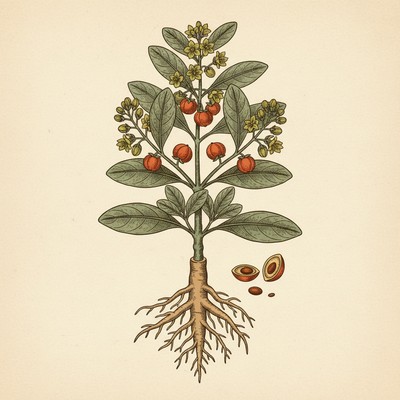
Withania somniferaAshwagandha is a prized root in Ayurvedic medicine, sometimes called 'Indian ginseng' (though botanically different from true ginseng) because of its rejuvenating properties. For over 3,000 years it's been used as a Rasayana (rejuvenative tonic) to strengthen the body, especially under stress. Ashwagandha is an adaptogen, helping modulate the stress response: it can calm anxiety and improve sleep, while at the same time enhancing daytime energy and stamina. The name Ashwagandha means 'smell of a horse' in Sanskrit—legend has it that taking it imparts the strength and vitality of a horse. It's commonly used today for stress-related exhaustion, mild hypothyroidism support, and overall vitality, making it a staple in modern herbal adaptogen formulas.
Traditionally used for
- Support the body's stress response and promote resilience
- Support energy, vitality, and reduce fatigue
- Promote restful sleep and support overall wellness
Quick facts
Pairs well with
Common questions
Can you mix ashwagandha and holy basil (tulsi)?
Yes. This is a natural pairing because both herbs are traditionally used to support the body's stress response. Their flavors balance each other: ashwagandha is earthy and bitter with a horsey edge, while tulsi is spicy, clove-like and warming. If the peppery taste dominates, begin with less of the stronger herb. Neither suits pregnancy or breastfeeding, and both may affect blood sugar. Holy basil may interact with blood-thinning medications, while ashwagandha may interact with thyroid medications and sedatives.
Can you mix ashwagandha and rhodiola?
This blend belongs in a morning cup. Rhodiola is traditionally taken earlier in the day because it may disrupt sleep, and sensitive people may find it causes jitteriness. That makes this a daytime pairing, although ashwagandha alone is traditionally used to promote restful sleep. Both taste bitter, with rhodiola adding a faint rose note. Neither is suitable during pregnancy or breastfeeding, and both have cautions involving blood pressure and blood sugar medications.
Can you mix ashwagandha and ginseng?
Although ashwagandha is sometimes known as Indian ginseng, the two plants are not botanically related. Both are traditionally used to support energy and reduce fatigue. Their flavors are similar, earthy and bitter, with ginseng contributing a little sweetness. Equal parts works well. Avoid this blend in the evening because ginseng can be overstimulating and is not intended for continuous long-term use. Both may interact with immunosuppressants and carry cautions concerning blood sugar.
What does ashwagandha taste like?
Ashwagandha tastes earthy and bitter, with a subtle horsey edge that can surprise first-time users. Its name offers a clue. In Sanskrit, ashwagandha means "smell of a horse," and the root of Withania somnifera lives up to it. You do not have to accept the flavor, though. Capsules, tinctures, teas and decoctions are all standard options for taking it.
Can you take ashwagandha at night?
Many people take it at night. Ashwagandha is traditionally used to promote restful sleep, but it is also traditionally used to support energy and reduce fatigue. That unusual double reputation is common among adaptogens. An evening tea or decoction is one option, while capsules and tinctures offer others. One important caution applies: ashwagandha may interact with sedatives. Speak with your healthcare provider before combining it with anything you already take at bedtime.
Who should avoid ashwagandha?
People who are pregnant or breastfeeding should avoid it. Ashwagandha is also unsuitable for those with autoimmune conditions, and it should be stopped before surgery. Withania somnifera may interact with thyroid medications, immunosuppressants and sedatives. It may also affect blood sugar and blood pressure, so anyone using medication to manage either should speak with a healthcare provider first.
How do you make ashwagandha tea?
Prepare ashwagandha as the root it is. Tea and decoction are both traditional preparations. A decoction involves simmering instead of steeping, the usual method for root material. The result tastes earthy and bitter, so pairing it with a warming herb can help. Holy basil works well and is also traditionally used to support the stress response. Begin with equal parts. Ashwagandha root itself is easy to find.
Safety
Avoid during pregnancy and breastfeeding. May interact with thyroid medications, immunosuppressants, and sedatives. May affect blood sugar and blood pressure. Avoid with autoimmune conditions. Discontinue before surgery.
These statements have not been evaluated by the Food and Drug Administration. This information is not intended to diagnose, treat, cure, or prevent any disease. Always consult a qualified healthcare provider before using herbs, especially if you are pregnant, nursing, taking medication, or have a medical condition.
More from the herb library
Blend Ashwagandha in the Yarrow app
Browse 100 herbs, build your shelf, and create blends from what you have.
100% Ad-Free · Some features require premium