Yarrow
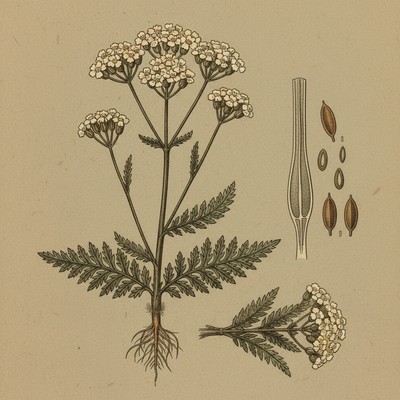
Achillea millefoliumYarrow has a legendary reputation on the battlefield—according to myth, Achilles used it to treat his soldiers' wounds (hence the Latin name Achillea). This feathery plant is a powerful astringent and styptic (stops bleeding), traditionally applied to cuts to speed healing and slow bleeding. Taken as a tea, yarrow is bitter and stimulates digestion, and it's also a diaphoretic herb used to induce sweating and help break fevers. Its anti-inflammatory and antimicrobial properties make yarrow a staple in traditional first-aid and cold remedies.
Traditionally used for
- Support wound healing and stop minor bleeding
- Support healthy inflammatory response
- Ease digestive discomfort and stimulate appetite
Quick facts
Pairs well with
Common questions
What is yarrow used for?
Yarrow has two main directions: skin and digestion. It is traditionally used to support wound healing and slow minor bleeding, reflecting the plant's astringent, styptic side. This is why Achillea millefolium is named after Achilles, who, according to legend, carried it for his soldiers' wounds. Its bitter tea is traditionally used to ease digestive discomfort and encourage appetite. Yarrow is also traditionally used to support a healthy inflammatory response.
What does yarrow tea taste like?
The first taste is bitter, followed by dryness. Yarrow's astringency can leave your mouth slightly puckered, with an aromatic quality beneath it all. It is not a gentle tea. Those who drink it alone often seek out that bitterness, since this quality is traditionally used to ease digestive discomfort and stimulate appetite.
Can you mix yarrow and calendula?
Yarrow and calendula overlap in nearly every way. Both are traditionally used to support a healthy inflammatory response. On the skin, calendula is traditionally used to soothe irritation and minor burns or scrapes, while yarrow is traditionally used to support wound healing and slow minor bleeding. Calendula tastes mildly bitter and slightly resinous, but yarrow dominates, so begin with less. Both belong to the Asteraceae family, meaning an allergy to one likely rules out the other. Each also has cautions involving pregnancy, sedative medications, and stopping before surgery. Yarrow has an additional interaction with blood thinning medication.
Can you mix yarrow and plantain?
Yes. Their contrasting textures make the blend work. Plantain feels mucilaginous, slippery, and soft in the mouth, balancing yarrow's drying quality. Their traditional uses also match: plantain for minor cuts, scrapes, and insect bites, yarrow for wound healing, and both for digestive comfort. Plantain is mild enough for equal parts. Neither should be used therapeutically inside the body during pregnancy. Plantain may interact with lithium, while yarrow may interact with blood thinners and sedatives.
Who should avoid yarrow?
Pregnancy is the clearest reason to avoid yarrow because it may stimulate the uterus. People sensitive to the Asteraceae plant family should also skip it. Yarrow may interact with blood thinning medications and sedatives, so discuss it with your healthcare provider before starting if you use either. Stop using it well before scheduled surgery. People often overlook that final caution, which applies equally to tea, tincture, and topical use.
Can you grow yarrow in containers?
Yarrow grows well in a pot, a useful quality because dried yarrow is generally found in specialty stores rather than supermarket tea aisles. Its feathery leaves also make it difficult to mistake for other balcony plants. Gather what you need fresh for a poultice, then dry the remainder for tea.
How do you make yarrow tea?
Begin with dried yarrow, typically bought from a specialty herb shop. Cover it with hot water and allow it to infuse, tasting along the way. The longer it steeps, the more bitter and astringent it becomes. Plain yarrow tastes sharp. Blending equal parts yarrow and plantain softens the dryness because plantain is slippery and mucilaginous. Calendula adds roundness while preserving the bitter note. If the flavor remains unappealing, tincture is another common preparation.
Safety
Avoid during pregnancy (may stimulate uterus). May cause allergic reactions in those sensitive to Asteraceae family. May interact with blood-thinning medications and sedatives. Avoid before surgery.
These statements have not been evaluated by the Food and Drug Administration. This information is not intended to diagnose, treat, cure, or prevent any disease. Always consult a qualified healthcare provider before using herbs, especially if you are pregnant, nursing, taking medication, or have a medical condition.
More from the herb library
Blend Yarrow in the Yarrow app
Browse 100 herbs, build your shelf, and create blends from what you have.
100% Ad-Free · Some features require premium